Education · 7 min read · July 30, 2026
Do creatine gummies work? What the research actually says.
Creatine gummies are everywhere. Most of them are underdosed. Here's how to tell the difference.
Creatine monohydrate is the most researched sports supplement on earth — hundreds of trials, decades of data, a safety record most ingredients would envy. Creatine gummies are much newer, and the internet is split between 'game changer' and 'scam.' The honest answer is that gummies work exactly as well as the creatine inside them, and the gap between brands is enormous.
The only question that matters: how much creatine is in there?
Creatine's benefits are dose-dependent. The literature converges on roughly 3–5g per day for maintenance, taken consistently, with no need for a loading phase unless you want saturation faster. A gummy that delivers a full daily dose does what a scoop of powder does. A gummy that delivers 500mg does about a tenth of it.
This is where most creatine gummies fail. Creatine is a bulky ingredient — fitting grams of it into a chewable takes real formulation work and costs real money. It's far cheaper to put a token amount on the label, print 'creatine' in large type, and let the category's reputation do the selling. Flip to the Supplement Facts panel and check the milligrams per serving, then check how many gummies a serving is.
Monohydrate vs everything else
Creatine HCl, buffered creatine, creatine ethyl ester, magnesium creatine chelate — each generation of alternative promises better absorption and fewer side effects. None has convincingly beaten monohydrate in head-to-head trials, and monohydrate remains the form used in nearly all the research showing strength, power, and lean-mass benefits.
It's also the cheapest form, which is why alternatives get marketed harder. If a product uses something other than monohydrate, the burden of proof is on the label, not on you.
Does creatine survive in a gummy?
The real technical concern with creatine gummies is stability. In water, creatine slowly converts to creatinine — an inert byproduct — and that conversion accelerates with heat, acidity, and time. A poorly formulated gummy can lose potency on the shelf, meaning the label number and the actual number drift apart.
Well-made creatine gummies manage this with low water activity, pH control, and packaging that limits moisture. What you can't control as a buyer is whether the brand tested for it. Third-party testing on finished product — not just on the raw ingredient — is the signal worth looking for.
Where gummies genuinely beat powder
Creatine powder is cheap and effective and sits unused in millions of cupboards. It's gritty in water, it needs a shaker, and it's easy to skip on days you don't train — which is exactly the wrong way to take creatine, since the benefit comes from keeping muscle stores saturated every day.
A gummy removes every one of those friction points. It travels, it needs no water, and it takes four seconds. For a supplement whose entire mechanism depends on daily consistency, format is not a trivial detail.
What to expect, and when
Creatine isn't a stimulant; there's nothing to feel on day one. Muscle stores saturate over roughly two to four weeks of consistent daily intake, and the effects show up as more reps at the same weight, faster recovery between sets, and a small increase in body weight from intracellular water — not bloat, and not fat.
If you stop, stores gradually return to baseline over several weeks. No cycling required, no dependency, no crash.
How to shop for one
Check three things and you'll filter out most of the market: the form is creatine monohydrate, the serving delivers a meaningful daily dose in a reasonable number of gummies, and the brand publishes third-party testing on the finished product. Everything else — flavor, color, packaging — is preference.
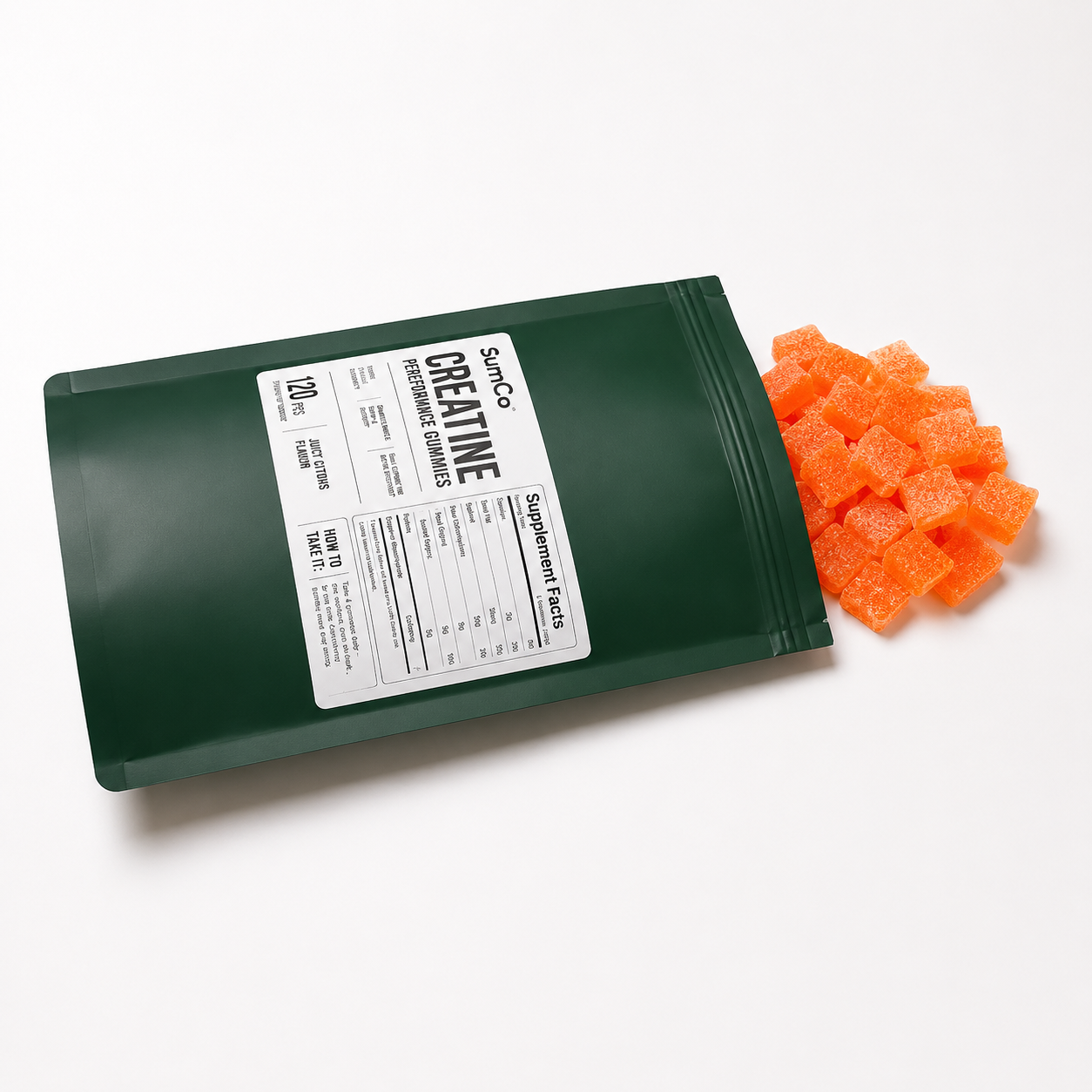
SumCo's Creatine Performance Gummies use creatine monohydrate at a full daily dose, with the entire panel printed on the label. No proprietary blends, no hidden amounts.
Common questions
- Do creatine gummies work as well as powder?
- Yes, when they contain an equivalent dose of creatine monohydrate and have been formulated to stay stable on the shelf. Creatine doesn't care what carried it into your stomach — it cares about total daily intake.
- How many creatine gummies should I take a day?
- Enough to reach roughly 3–5g of creatine monohydrate daily. Read the Supplement Facts panel — serving sizes vary widely between brands.
- Do I need to load creatine?
- No. Loading (around 20g/day for a week) saturates muscle stores faster, but a steady daily dose gets you to the same place in about three to four weeks with less GI upset.
- Will creatine make me bloated?
- Creatine draws water into muscle cells, not under the skin. Most people see a small weight increase early on; visible bloating is usually a symptom of very high loading doses, not maintenance dosing.
- Should I take creatine on rest days?
- Yes. The benefit comes from keeping muscle stores saturated, which means daily intake regardless of whether you train that day.