Education · 6 min read · July 30, 2026
Caffeine gummies vs coffee: dose, onset, and the crash.
Same molecule, very different experience. The variables are dose precision and what's paired with it.
Coffee is the default caffeine delivery system for most of the world, and it works. But 'a cup of coffee' is one of the least precise doses in nutrition — anywhere from 60mg to 200mg depending on bean, roast, grind, and barista. If you've ever had one coffee too many by accident, the problem wasn't caffeine. It was measurement.
Dose precision is the real difference
A caffeine gummy states its dose on the label: 100mg means 100mg, every single time. Coffee varies by a factor of three between a light-roast pour-over and a dark diner refill, which makes it nearly impossible to find and hold your personal sweet spot.
Most adults do well somewhere between 100mg and 200mg per sitting. Knowing exactly where you are on that scale is what separates 'alert' from 'wired and slightly anxious.'
Onset: faster than you'd expect
Caffeine from a beverage typically peaks in the blood 30–60 minutes after drinking. A chewable that partly dissolves in the mouth can begin absorbing sooner, and most people notice something within 15–20 minutes.
For a pre-workout window or a mid-afternoon deadline, that difference is practical rather than academic.
Why the crash happens (and what actually prevents it)
Caffeine works by blocking adenosine receptors. Adenosine keeps accumulating while it's blocked, so when caffeine clears, the backlog binds at once — that's the crash. Nothing about coffee versus gummies changes this mechanism.
What does change it: total dose, timing, and pairing. Overshooting the dose makes the drop steeper. Caffeine after roughly 2pm eats into sleep quality for many people, since its half-life runs five to six hours. And pairing caffeine with L-theanine — the amino acid naturally present in tea — reliably smooths the peak in controlled studies, reducing jitters while preserving the attention benefit.
The L-theanine pairing
Caffeine plus L-theanine is one of the better-supported combinations in the cognitive literature. The pairing improves attention-switching and reduces the subjective feeling of being overstimulated compared with caffeine alone.
Coffee doesn't contain L-theanine; green tea does, which is part of why tea caffeine feels 'softer' despite being the same molecule. A well-formulated caffeine gummy can build that ratio in deliberately instead of leaving it to chance.
Where coffee still wins
Coffee is a ritual, it's hot, it tastes like coffee, and it comes with polyphenols a gummy doesn't have. If the morning cup is part of your day rather than just a delivery mechanism, keep it.
Gummies make more sense for the second dose: the pre-workout, the flight, the 3pm wall — situations where you want a known amount, no cup, and no acidity on an empty stomach.
Practical dosing
Start with 100mg and note how you feel at 30 and 90 minutes. Keep total daily intake under roughly 400mg for most healthy adults. Set a personal cutoff time about eight hours before bed. And don't stack a caffeine gummy on top of coffee you've already forgotten about — precision only helps if you count everything.
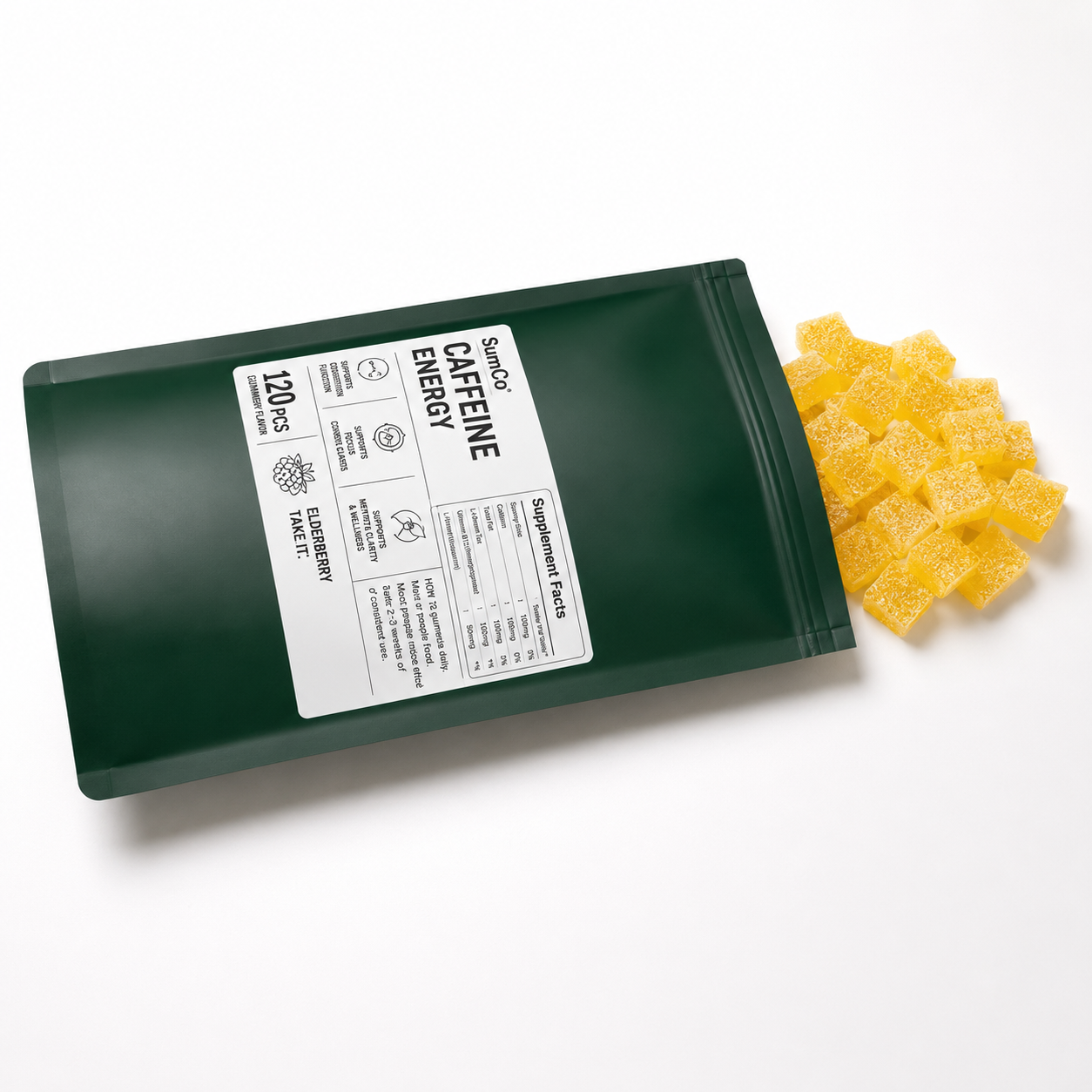
SumCo's Caffeine Energy Gummies pair 100mg of natural caffeine with L-theanine and B12, dose printed on the label.
Common questions
- How much caffeine is in a caffeine gummy vs a cup of coffee?
- A typical caffeine gummy delivers a stated 100mg. A cup of coffee ranges from roughly 60mg to 200mg depending on the bean, roast, and brew, so the gummy is far more predictable.
- Do caffeine gummies work faster than coffee?
- Often slightly. Coffee peaks in the blood around 30–60 minutes; a gummy that partly dissolves in the mouth can start absorbing sooner, with most people noticing effects in 15–20 minutes.
- Do caffeine gummies cause a crash?
- Any caffeine can, because the crash comes from accumulated adenosine binding once caffeine clears. Moderate dosing, an early cutoff time, and pairing with L-theanine all soften it.
- How many caffeine gummies can I take in a day?
- Most healthy adults should stay under about 400mg of total daily caffeine from all sources — coffee, tea, and energy drinks included.
- What does L-theanine do with caffeine?
- L-theanine is an amino acid found in tea that blunts the jittery edge of caffeine while preserving its attention benefits, which is why the combination is so well studied.